AgentForce is only as Smart as your Dumbest Spreadsheet
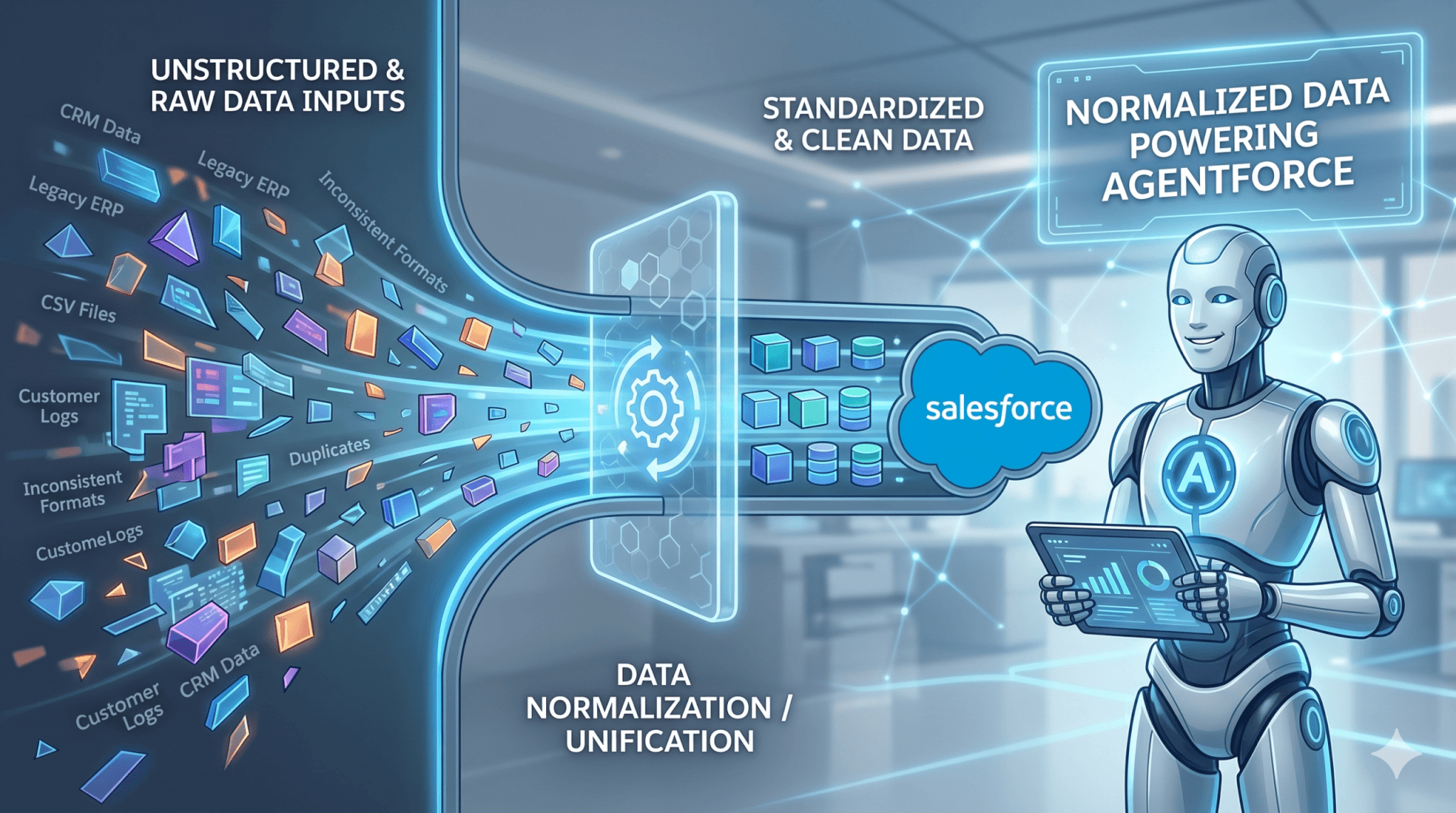
I once spent more than than I'd like to admit staring at a dashboard that claimed a single customer had bought the same industrial cooling unit fourteen times in three hours. He hadn’t. The system was just tripping over itself because his name was entered as "J. Doe," "John Doe," and "Doe, John" across three different legacy databases. While a human can squint at that and see the truth. An autonomous agent? Not so much. It just sees a ghost in the machine and starts firing off automated emails that make your company look bad and erodes trust with your customers.
Deploying Salesforce’s AgentForce without strict data normalization is like giving a Ferrari to someone who’s never seen a steering wheel. It’s fast, powerful, and guaranteed to hit a wall.
The Agent is Only as Smart as the Table
AgentForce doesn’t "think" the way we do. It executes based on the pathways and data structures you provide. If your data is a mess of redundant fields, inconsistent date formats, and duplicate records, the agent’s reasoning engine starts to hallucinate. It tries to bridge the gaps between disparate data points and ends up making very confident and very incorrect decisions.
Normalization isn't just about tidying up; it's about reducing redundancy. You want a single source of truth. When an agent looks for a customer’s lifetime value, it shouldn’t have to choose between three different "Total_Spend" columns located in three different objects. If it has to choose, given enough time, it will eventually choose wrong.
Why "Clean" Isn't Enough
Most people think cleaning data means deleting the typos. That’s the bare minimum. Normalization is deeper. It’s the architectural process of ensuring every piece of data lives where it belongs and nowhere else.
The catch is that agents rely on relationships. If your "Orders" table isn't properly linked to your "Accounts" table through a unique, standardized ID, the agent loses the thread. I’ve seen deployments where the AI was tasked with proactive outreach, but because the phone numbers weren't normalized to E.164 format, the agent couldn't trigger the dialing API. The logic was there, but the data was a dead end.
The Logic Loop Trap
When data isn't normalized, you create "logic loops." Imagine an agent tasked with identifying "High Value" clients. In one database, high value is defined by a checkbox. In another, it’s a calculated field based on 12 months of spend.
If AgentForce encounters both, it might trigger two different workflows for the same person. Suddenly, your VIP client is getting a "Welcome" discount code and a "We Miss You" retention offer at the same time. This doesn't just look sloppy; it erodes the trust required to let an autonomous agent handle customer-facing tasks.
The Cost of the "Quick Fix"
There is always a temptation to use middleware or "wrapper" code to patch over ugly data. I’ve tried it. It works for a week. Then a schema changes or a new API version drops, and the whole house of cards collapses.
AgentForce is designed to be agile. It’s meant to pivot based on real-time inputs. If that input is buried under layers of un-normalized junk, the "reasoning" phase of the agent’s cycle takes longer. In a world where we measure AI performance in tokens and milliseconds, inefficient data is a literal tax on your budget.
Moving the Needle
You have to get aggressive with your schema. This means:
-
Enforcing strict picklist values instead of open text fields.
-
Consolidating duplicate fields that drifted apart over years of different admins.
-
Standardizing naming conventions so the agent’s "brain" doesn't have to guess if
Acct_NumandCustomer_IDare the same thing.
Some projects may require you spending as much as sixty percent of the budget just on data restructuring before you even turned the AI on. This makes a lot of stakeholders restless because it is natural to want the "magic" immediately. However, if we do this and do it correctly, when we finally flip the switch, the agent is going to work perfectly because the path was leveled and paved.
If you feed an agent a swamp, don't be surprised when it gets stuck in the mud. Build a foundation of normalized data first, or you're just automating your own chaos and we know that fixing chaos can be very expensive.