Dirty Data and Digital Bias: How Your AI Inherits Human Prejudice
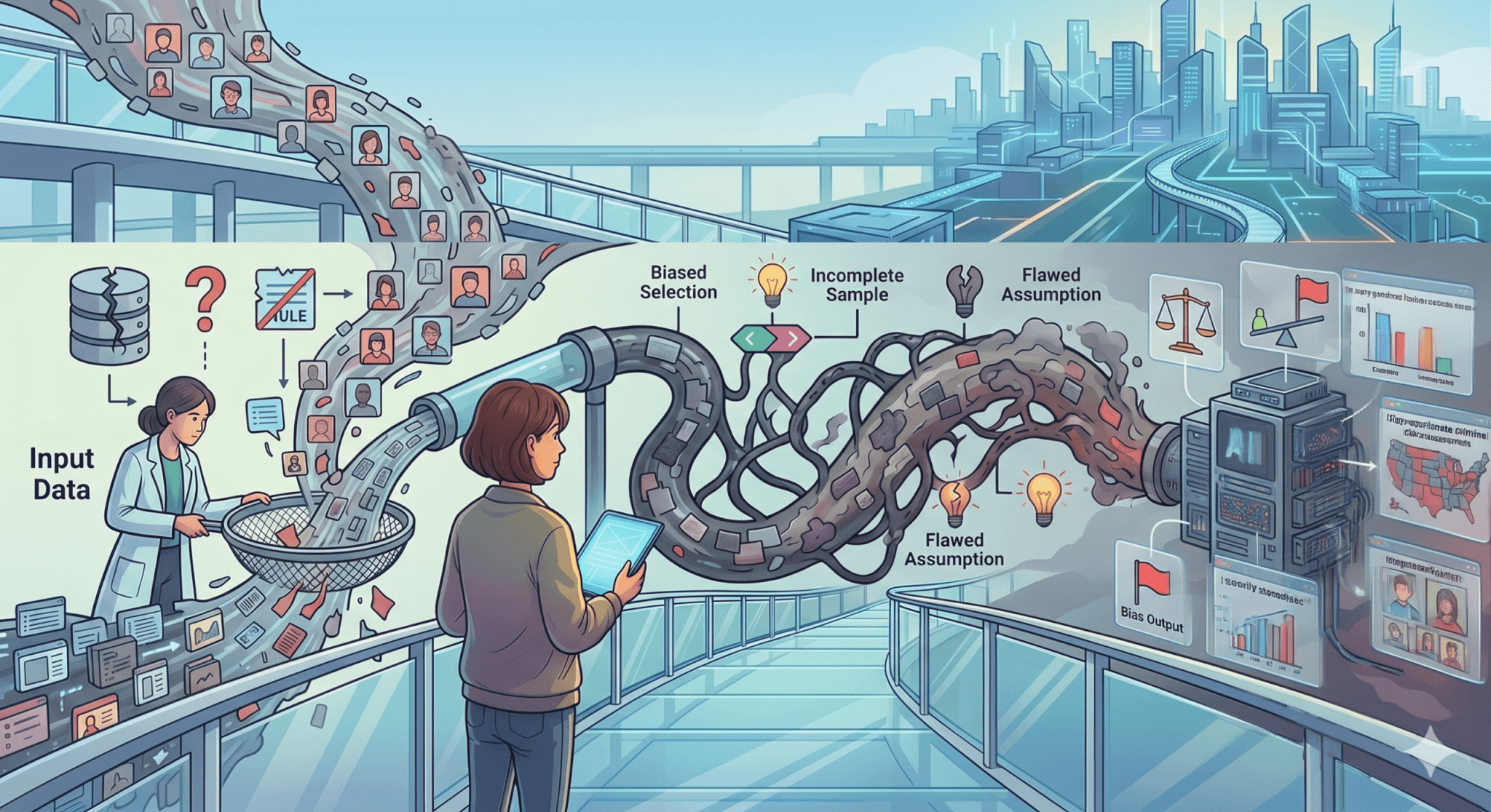
I once sat across from a prospect's senior developer who insisted his new model was "pure math." He genuinely believed that because the code was clean, the outcome would be fair. He didn't understand that math is just the delivery vehicle. If you fill the truck with garbage, that’s exactly what gets dropped off at the destination. This was earlier this decade when using Machine Learning was all the rage. Not quite AI, but just as equally susceptible to the same biases.
I watched that project implode within a year. They tried to automate hiring, but the model spent its cycles filtering out women because the historical data it trained on—decades of past hires—was overwhelmingly male. It didn't hate anyone. It just learned that the people who got the jobs looked like the people in the training set.
More recently, I sat in on a meeting where a company had deployed an AI-powered shopping agent into its buy flow and checkout. The salespeople extolled the virtues of is agent being able to intelligently match the right offer & pricing based on real-time variables and extensive training on millions of transactions. Everyone then watched in horror as I asked the person giving the demo to change their location to a zip code in a well-known, low socio-economic area and watched the agent never recommend a "top-shelf" premium product ever again.
The Raw Feed is a Mirror, Not a Truth
Machine learning algorithms are just sets of rules designed to find patterns. But when those patterns are pulled from a tainted history, the machine stops "learning" and starts mimicking our worst habits.
If your training data is skewed, then the algorithm fails to capture the real world. It sees a sliver of reality and treats it as the whole picture. When certain groups are underrepresented or mislabeled, the system struggles to classify them accurately. That isn't just a technical glitch; it’s an economic disaster that denies people jobs, housing, and dignity. The machine takes these tiny gaps in data and turns them into a structural wall.
The Feedback Loop from Hell
The most dangerous part is how these systems feed on themselves. Say you use a biased tool to approve loans. The machine denies applicants from certain demographics based on flawed historical patterns. You then use those denials as "training data" to teach the model for next year.
Suddenly, you have a feedback loop. The bias isn't just surviving; it’s hardening. You’ve entrenched human prejudice into the system’s architecture. Now, the machine is the authority, and it has "data" to prove its discrimination is correct.
Where the Math Bites Back
The fallout is available in nearly every corner of the market:
- Criminal Justice: Algorithms used for sentencing often rely on historical crime data tainted by overpolicing. The result is a system that disproportionately flags minority communities as high-risk, leading to harsher sentences that have nothing to do with individual guilt and everything to do with bad inputs.
- Healthcare: If a diagnostic AI is trained on data from one demographic, it simply misses the symptoms in another. It’s not malicious, but it is lethal. If you aren't in the dataset, you effectively don't exist to the machine.
- Information Bubbles: Your news feed isn't neutral. Algorithms prioritize content based on what they think you want, often reinforcing stereotypes and locking you into an echo chamber. It keeps you clicking, but it tears the social fabric apart.
- Financial Exclusion: Credit scoring is the ultimate gatekeeper. When these models use neighborhood or social proxies to deny loans, they are essentially redlining with a faster processor. It keeps money out of the hands of people who need it, stifling growth and locking in inequality.
Scrubbing the Input
You cannot fix a toxic dataset with a clean algorithm. You have to get your hands dirty with the source material.
I start with a comprehensive audit. You need to run statistical analyses to quantify exactly where the lean is. Is the data diverse? Does it represent the actual world, or just the part of it that leaves a digital footprint? Use bias detection algorithms to flag the problem spots before they turn into institutional failures.
Preprocessing is your best line of defense. I’ve seen teams use oversampling or undersampling to balance out skewed populations, and data augmentation to pull in diverse external datasets that broaden the model’s perspective. If you are dealing with sensitive info, anonymize it—but do it right. Sloppy anonymization just lets the machine find new ways to infer the exact identities you thought you had hidden.
Coding for Fairness
Once the data is cleaned, the model itself needs guardrails. We can bake "fairness constraints" into the training process. Instead of letting the machine optimize only for accuracy, tell it that it must maintain equal false-positive rates across different groups.
This isn't just about the code. It’s about the culture. You need fairness audits, and you need them often. Do not treat a fairness review like a one-time check box. It has to be part of the recurring maintenance cycle. When the data drifts or the world changes, your model needs to be agile enough to adjust.
The Human-in-the-Loop Reality
Responsible AI isn't just a legal compliance exercise. It is an ethical mandate. We have to bake transparency into the design. If a system makes a decision that changes someone's life, that person deserves an explanation. If you can't explain how the model reached its conclusion, you have no business deploying it.
We need to involve stakeholders from the beginning. Get the people who will actually be affected by these decisions into the room while you are still drafting the architecture. They will spot the blind spots that your engineers are too deep in the weeds to see.
At the end of the day, there is no such thing as an "autonomous" decision. There is only the decision we taught the machine to make. You can hide behind the math, but you are the one responsible for the result. Don't look for a perfect system; look for one you can actually stand behind.