Palantir Ontology 101: Stopping the Bleeding Before You Automate the Mess
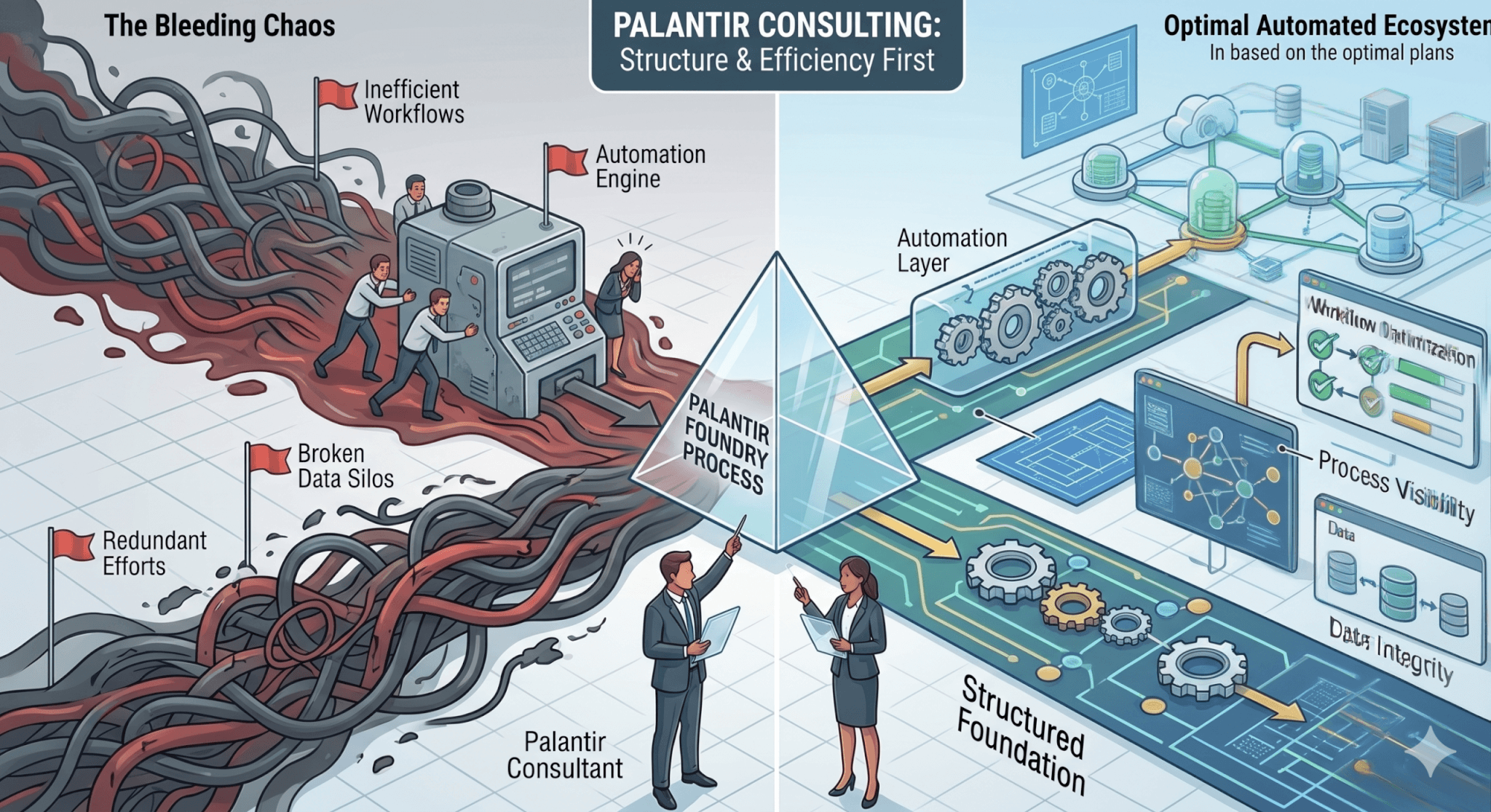
Most data teams treat their infrastructure like a hoarder’s basement. They keep everything. Hoping that one day they’ll find a use for a pile of rusted spreadsheets and dead SQL queries, they refuse to delete a single row. I’ve walked into enough boardrooms to see the exact same tragedy play out. Millions get burned on massive integrations that just act as dumping grounds for garbage. The Palantir Ontology stops this bleeding. It forces your business logic directly into the code.
Translating Reality into Nouns and Verbs
To understand Palantir Foundry, you have to stop thinking in rows and columns. Think in nouns, adjectives, and verbs. Raw data is entirely useless until it accurately reflects reality. That is the fundamental purpose of the Ontology. Sitting on top of your chaotic data integration layer, it translates digital noise into a language humans actually speak.
We call the core nouns Objects. A customer, a factory, a sensor, a commercial flight.
The adjectives attached to them are Properties. The customer’s current loyalty tier, the factory’s physical location, the sensor’s real-time temperature.
The verbs connecting everything are Links. The customer places an order. The factory produces a specific part.
I once spent a grueling month trying to reconcile a client’s disparate global systems. Three different ERPs and four conflicting CRM instances were running the show. Every single department spoke a different dialect. Their data existed as a series of disconnected, untrustworthy islands.
We ignored the underlying database schemas entirely. Sitting around a whiteboard, my team sketched the physical business flow instead. We defined a single "Global Account" Object. By building that structural definition, we forced the underlying data to behave according to real-world physics, regardless of whether a purchase originated from a regional distributor in France or a direct web portal in the US.
The Mechanics of a Unified Reality
Take a scenario where you track a high-value client across three separate companies under one corporate umbrella. Company A handles hardware sales. Company B manages ongoing service contracts. Company C oversees aftermarket parts.
If you rely on raw transactional data, you see three completely different customers. Your sales reps end up calling the exact same person three times a week with conflicting offers. The entire organization looks wildly incompetent to the buyer.
The Ontology fixes this by permanently connecting the dots. You map the "Purchase" from Company A, the "Service Ticket" from Company B, and the "Warranty Claim" from Company C to that single Global Account Object via Links.
Now a rep opens their terminal and sees the entire lifecycle of that client in one view. They notice an angry client with an open, unresolved ticket in Company B. Skipping the standard sales pitch, the rep fixes the problem first. That is the actual difference between storing data and possessing intelligence.
Closing the Loop with Actions and Writeback
Dashboards are where data goes to die. You look at a colorful chart, figure out something is wrong, and then log into five other isolated systems to actually do something about it.
Palantir changes that broken workflow through Actions and Writeback. An Action is a specific piece of operational logic tied directly to an Object. If a supply chain manager sees a delayed shipment, they do not open an email client to complain. They click a button right on the Shipment Object to re-route the truck.
Here is why that matters. The Ontology executes that Writeback directly into the source system. Automatically, the primary ERP updates. Operational reality shifts instantly. You collapse the space between seeing a problem and fixing it.
Kill the Complexity Before It Kills You
People fail at this implementation because they get greedy. They try to map every single attribute into the Ontology Manager on day one. Adding hundreds of useless Properties to a single Object type, they end up with a model so bloated that nobody can navigate it.
Start with the core operational decision. Figure out the one move that actually shifts the bottom line. Is it predicting a severe supply chain bottleneck? Is it stopping a massive fraud event before the funds clear?
Build for exactly that outcome. If a piece of data fails to help you make a decision or execute an Action, cut it immediately. You want a surgical tool. You do not need a bloated software suite missing half its functional features.
The Boardroom Reality Check
You have to be the one enforcing this discipline. Developers always want to chase perfect data hygiene and perfect operational conditions in which to run their code. Executives always demand to see every metric at once. Your job is to stand firmly in the middle and force them all to focus.
Treat your operational logic as the absolute core of your software. When you do that, the platform transforms into a nervous system. You stop reporting on what happened yesterday. You start steering what happens tomorrow.
If you fail to describe your Object model to someone over a coffee without getting lost in technical jargon, you have already lost the plot. Go back to the whiteboard and erase the noise.