What Do I Need to Do to My Ecommerce Website for Universal Commerce Protocol?
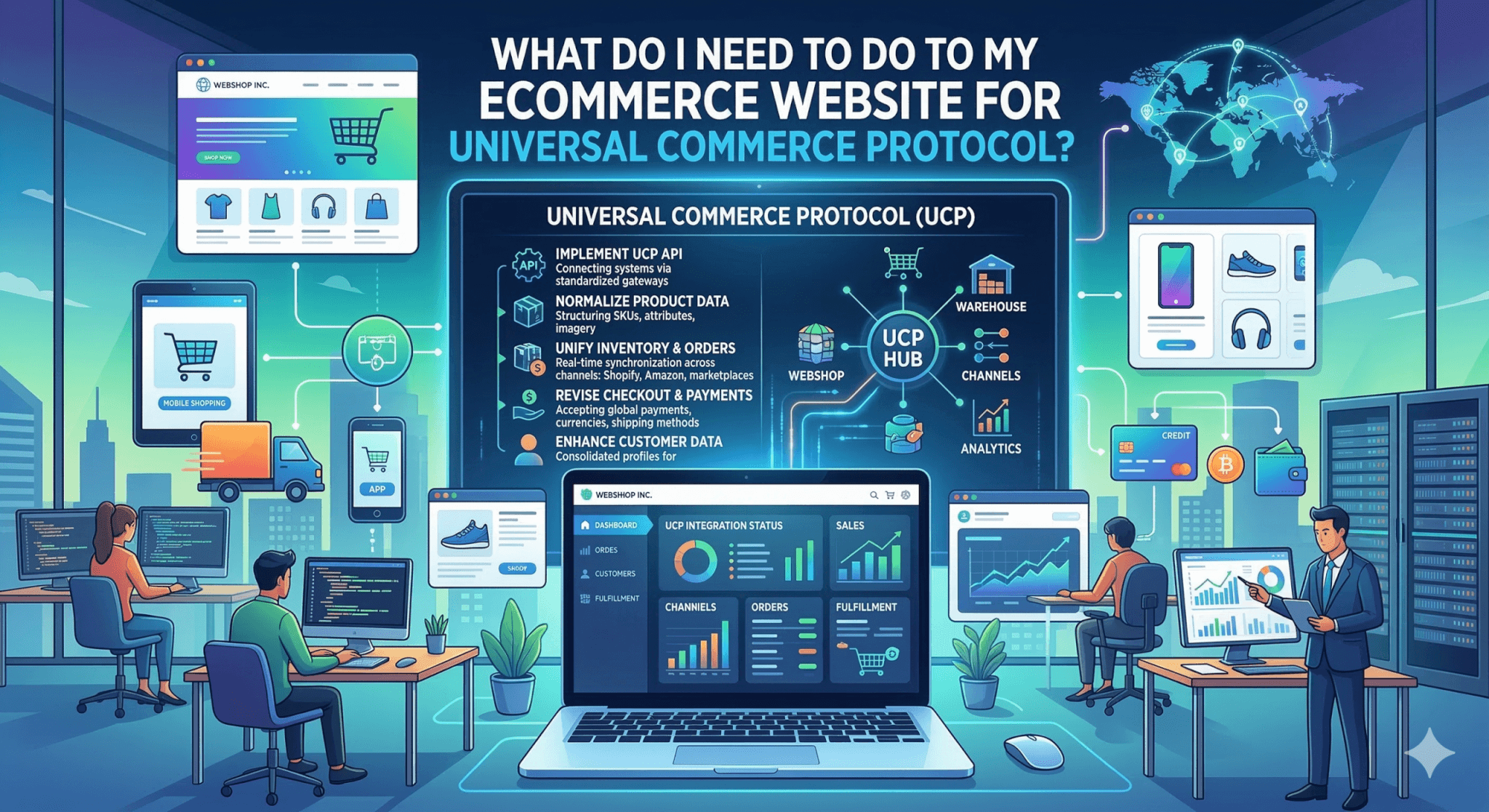
I’ve spent the last two decades watching brands obsess over "user experience." They spend months arguing over the shade of a "Buy Now" button or the milliseconds it takes for a high-res image to load. But here’s the cold truth: the most important "user" of your website in 2026 isn't a human with a mouse. It’s an AI agent with an API key.
SEO for ecommerce is about to get far more technical - much to the chagrin of SEO consultants and agencies who just cannot seem to catch a break in the face of declining traffic numbers.
The Universal Commerce Protocol (UCP) is essentially a "USB-C port" for your store. It allows agents—like Gemini or specialized shopping bots—to plug directly into your business logic, bypass your flashy frontend, and execute a purchase.
If your website is built like a brochure, you’re in trouble. To thrive under UCP, your website needs to stop being a destination and start being a service provider. You need to move from a world where you show products to one where you programmatically declare them.
The protocol doesn't care about your branding; it cares about your manifest. It checks a specific file on your server (the /.well-known/ucp endpoint) to see what you’re capable of. Can you handle guest checkout? Do you support specific loyalty points? If the answer isn't in the code, the agent is gone before the first pixel of your logo would have even rendered.
10 Actionable Ways to Win the UCP Game
If you want to be the merchant that the bots actually trust, you need to stop "optimizing" and start "standardizing." Here are ten high-value moves to get your site UCP-ready.
1. Publish Your .well-known/ucp Manifest
This is step zero. Without a discovery manifest, you don't exist in the UCP ecosystem. This JSON file tells agents exactly which "capabilities" you support (e.g., discovery, checkout, fulfillment). It’s the digital handshake that starts every transaction.
2. Activate the native_commerce Attribute
In your Google Merchant Center feed, there’s a new toggle: native_commerce. If this is set to false or missing, your products are "view only." Setting it to true is the explicit permission slip that tells AI agents they are allowed to buy that specific SKU programmatically.
3. Move to Real-Time Inventory "Push"
Agents hate "out of stock" errors at checkout. It kills your reliability score. Instead of waiting for a daily feed pull, implement a system that pushes inventory changes to the protocol the second a warehouse shelf empties. Reliability is the new SEO ranking factor.
4. Transition to Server-Side Tracking
When an agent buys a product through Gemini, there is no "browser" for your Facebook Pixel or GA4 tag to fire in. If you rely on client-side tracking, your analytics will go dark. You must implement server-side purchase confirmations to capture every UCP-driven sale.
5. Map Every "Decision-Making" Attribute
Descriptions are for humans; attributes are for agents. I once saw a tent manufacturer lose thousands in sales because they didn't have a "setup_time" field. The agent was told to find a "tent that sets up in under 5 minutes," and because that data was buried in a paragraph instead of a structured field, the bot skipped them.
6. Implement "Requires_Escalation" Logic
Sometimes a bot can't finish the job—maybe a custom engraving is needed or a specific legal waiver. UCP allows for "escalation," where the agent hands the human back to a specific continue_url on your site. Make sure your checkout state machine can resume a session mid-stream without making the user start over.
7. Clean Up Your Parent-Child SKU Logic
Agents get confused by "messy" variants. If you have five different pages for the same shirt in different colors, the agent might see them as five separate, competing products. Consolidate your data into a clean parent/child structure so the bot understands it’s one product with five options.
8. Standardize Units of Measure (UoM)
The protocol doesn't like doing math. If your API returns weights in pounds but the agent is searching in grams, you’re introducing "identity friction." Pick a global standard (like ISO) for all technical specs and stick to it across your entire catalog.
9. Expose Machine-Readable Policies
Your "30-day return policy" needs to be more than a link in your footer. It needs to be part of your UCP capability response. Agents need to know the cost of shipping, the return window, and tax obligations as structured data (JSON-LD) to calculate the "total cost of intent" for the user.
10. Prioritize API "Lean-ness"
Speed still matters, but it’s now about payload speed. When a UCP agent pings your checkout endpoint, it wants a clean, structured response—not a 2MB JSON blob full of legacy junk. Audit your API responses and strip out anything that isn't strictly required by the protocol.
The shift to UCP is the end of "vague" ecommerce. You are no longer selling to a person who might be swayed by a pretty photo; you are selling to a protocol that demands precision.