What is RAG & why should I care?
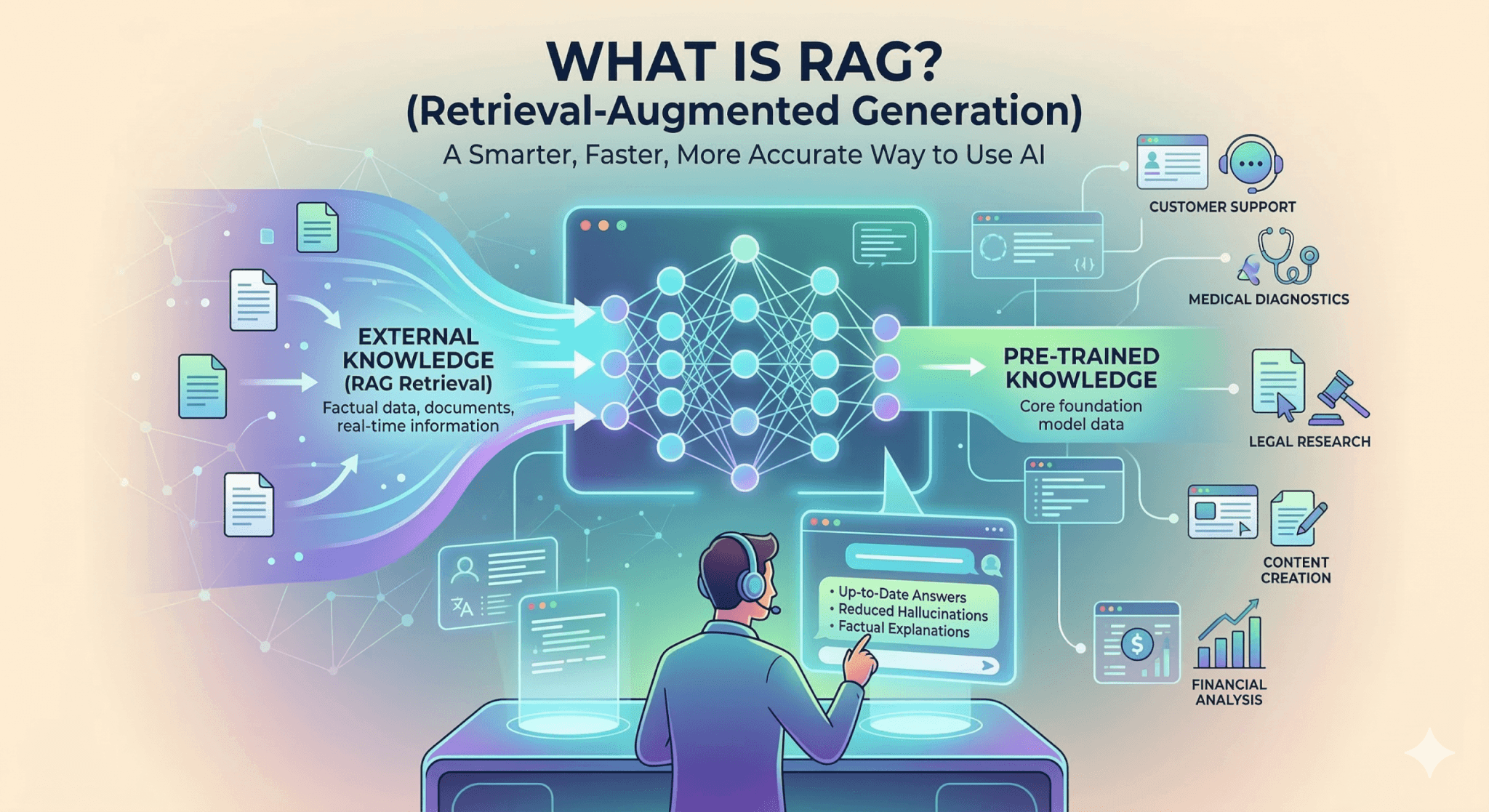
Retrieval-Augmented Generation (RAG) helps agents not make things up.
Forget the glossy marketing decks. If you spent 2025 watching LLMs hallucinate legal advice or confidently lie about your company’s Q4 revenue after consuming countless balance sheets and P&Ls, you know the "base" models are essentially brilliant interns with zero short-term memory. They’ve read the internet, but they haven't read your files.
That’s where Retrieval-Augmented Generation (RAG) comes in. It’s not a new model; it’s a plumbing job. I’ve heard of teams spending six months or more trying to "fine-tune" a model to learn their internal data, only to realize they could have built a RAG pipeline in a weekend for a fraction of the cost.
Here is the quick and dirty reality of how RAG works and how to actually use it to build agents that don't make things up.
The "Open Book Exam" Strategy
Standard AI is like a student taking a test from memory. RAG is giving that student a textbook and a search engine. When a user asks a question, the system doesn't just "think"—it looks things up first.
The process is simple:
- Retrieve: Find the relevant chunks of data in your knowledge base.
- Augment: Stuff those chunks into the prompt window.
- Generate: Let the AI write the answer based only on that info.
I once worked on a project where a support bot was hallucinating refund policies. We switched to RAG, restricted the prompt to "answer only using the provided text," and the errors dropped to near zero overnight.
The Stack You Actually Need
In 2026, you don't need a PhD to set this up. You need three things:
- A Vector Database: Think of this as a library where books are shelved by "vibe" (meaning) rather than just title. Pinecone, Weaviate, or even local FAISS work fine.
- Embeddings: These turn your text into numbers. This is how the computer "understands" that a query about "yearly leave" is the same thing as a document about "vacation policy."
- An Orchestrator: LangChain or LlamaIndex are the standard. They do the heavy lifting of connecting the database to the AI.
From Chatbots to Agents
The catch is that basic RAG is "dumb." It just grabs the top three results and hopes for the best. If you want to build an actual Agent, you need to give the AI a steering wheel.
Agentic RAG is the real frontier. Instead of a straight line (Query → Search → Answer), it’s a loop. The agent looks at the query and asks itself: "Do I have enough info to answer this?" If the search results are garbage, the agent doesn't just guess. It rewrites the search query and tries again.
I’ve seen this save a supply chain agent that couldn't find a specific SKU because the user's typo was too messy. The agent recognized the failure, searched for a broader category, and found the right item anyway.
Stop Guessing, Start Grading
If you aren't measuring your RAG, you aren't building—you’re praying. Use a framework like RAGAS to check three things:
- Faithfulness: Did the AI stick to the facts?
- Relevancy: Was the retrieved info actually useful?
- Recall: Did it find all the info, or just a piece of it?
The era of "vibes-based" AI development is over. In 2026, the winners are the ones who treat their data like a structured resource and their agents like skeptical investigators.
Keep your pipelines tight and your temperature low. It keeps the professional relationship intact while ensuring the work actually gets done.
That's fine Tom, but what do I actually need to establish a RAG pipeline?
Great question.
The plumbing isn't as intimidating as the consultants and whitepapers make it sound. Think of a RAG pipeline as a high-speed conveyor belt that turns a massive pile of messy PDFs into a neat, one-sentence answer.
If you’re building this today, you’re looking at two distinct phases: the Ingestion Loop (preparing the data) and the Inference Loop (answering the user).
The Ingestion Loop: Prep the Library
You can’t just point an AI at a folder of Word docs and hope for the best. You have to "digest" them first.
- Chunking: This is where most people fail. You break your documents into smaller pieces—maybe 500 words each. If the chunks are too big, the AI gets distracted; too small, and it loses the context. I’ve seen better results by overlapping the chunks by 10% so no information falls through the cracks at the edges.
- Embedding: You run those chunks through an embedding model. This turns "Our office is closed on Christmas" into a string of numbers like
[0.12, -0.98, 0.45...]. These numbers represent the concept of holidays. - Indexing: You shove those numbers into a Vector Database. Now, your data is searchable by meaning, not just keywords.
The Inference Loop: The Hand-Off
This is what happens the millisecond a user hits "Enter."
- The Transformation: The user asks, "When do I get a day off?" The system turns that question into the same kind of number string (embeddings) used in the ingestion phase.
- The Retrieval: The system scans the Vector Database. It finds the "holiday" chunk because the numbers are mathematically close to the "day off" numbers.
- The Context Stuffing: Here is the "Augmented" part of RAG. You take that holiday chunk and the user's question and wrap them in a prompt: "You are a helpful assistant. Use ONLY the following text to answer the question: [Holiday Chunk]. Question: [User Question]."
- The Delivery: The LLM reads that specific prompt and spits out: "The office is closed on Christmas."
Where Agents Break the Pipe
The catch is that a standard pipeline is a one-way street. If the "Retrieval" step pulls a document about HR benefits instead of the holiday calendar, a basic bot will still try to answer. It’s "Garbage In, Garbage Out" at its finest.
An Agentic Pipeline adds a "Reviewer" step. Before the answer goes to the user, the agent asks: "Does this document actually mention holidays?" If the answer is "No," the agent loops back, rewrites the search query to be more specific, and hits the database again.
You can cut your current hallucination rate by up to 40% by just by adding this simple self-correction loop. It turns a fragile pipeline into a robust system.
Specifics?
Here is the blueprint for the current state-of-the-art RAG stack.
The "Big Three" Orchestrators
You need a framework to manage the flow of data. While there are dozens, these three own the space:
- LlamaIndex: If your primary goal is "chat with my data," start here. It has the best out-of-the-box performance for indexing complex documents (like those messy nested PDFs) and is generally more "plug-and-play" for RAG.
- LangGraph (within the LangChain ecosystem): This is the choice for building Agents. Unlike standard chains, LangGraph allows for "loops"—meaning the AI can search, realize it failed, and try a different search query.
- smolagents: A newcomer that’s gaining heat for being "code-first." It treats agent actions as small Python snippets, which is much more reliable than asking an AI to guess which JSON tool to call.
The Memory: Vector Databases
This is where your chunks live. You aren't just storing text; you're storing the meaning of that text.
| Database | Best For | Why Use It? |
| ChromaDB | Prototyping | It’s local, fast, and lives in your RAM. Perfect for a weekend project. |
| Pinecone | Production | Fully managed and serverless. It handles the scaling so you don't have to manage a cluster. |
| pgvector | Existing Stacks | If you already use PostgreSQL, just add the extension. No need for a new "AI database." |
The Eyes: Embeddings and Models
To turn words into numbers, you need an embedding model.
- Voyage AI (
voyage-3.5): Currently the "retrieval king" for high accuracy at low cost. It has a massive context window, which means you can be lazier with your chunking. - BGE-M3 (Open Source): The Swiss Army knife. It’s multilingual and works incredibly well if you want to host the model yourself rather than paying for an API.
- Llama-3.1-Nemotron: If you need top-tier "reasoning" to decide which chunks are actually relevant. Llama's over all strengths (at the tie of writing) are due to their being specifically tuned to handle multi-step deduction.Instead of jumping to a conclusion, they are trained to break down problems into sequential logical units.
The Safety Net: Evaluation
The most important library you’ll install is RAGAS or DeepEval. These tools don't just "check" the answer; they grade the pipeline.
I once saw a project where the RAG system looked perfect in demos but was secretly failing 20% of the time. We plugged in DeepEval and realized the "retriever" was grabbing outdated versions of the company's contracts. We fixed the chunking logic in an hour—something we never would have caught by just "eyeballing" the chat logs.