Why Your AI is a Terrible Strategic Thinker (And How To Fix It)
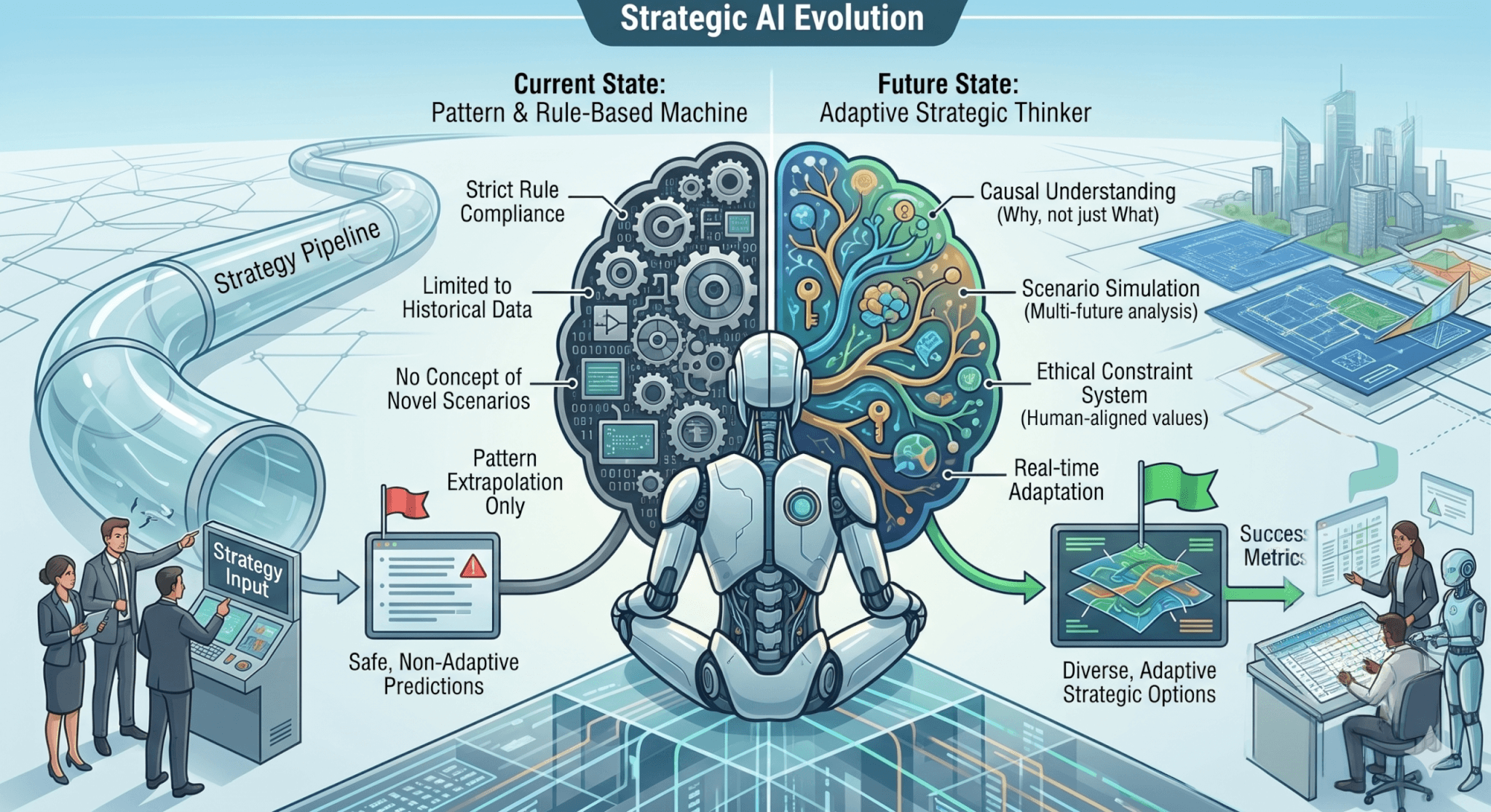
I recently watched a "proof of failure" video where a high-priced enterprise bot promised a customer a full refund on a non-refundable, custom-built product just because the user sounded frustrated. The bot was "helpful," "polite," and "empathetic." It was also dead wrong. It had no concept of the company's internal financial rules, pricing or RMA authorization so it just hallucinated a policy that cost the firm thousands of dollars.
In this case, the model isn't "stupid." It’s just being asked to run a marathon without being told where the finish line is. If you want an AI to solve actual problems instead of just sounding confident while failing, you have to bake reasoning along with governance into the architecture. Stop asking for the "answer" and start asking for the "process."
Show The Work or Fail: CoT Reasoning Model
Expecting a transformer to jump from a complex prompt to a correct answer in one leap is setting it up for disaster. Chain-of-Thought (CoT) is the fix. You force the model to "think out loud" before it gives you the result.
I recently worked on a logistical routing project in Palantir where the model kept hallucinating impossible distances between stops. The fix wasn't more training data. We just changed the prompt to require a step-by-step breakdown of every stop on the route before calculating the total. By the time the model reached the end of its internal monologue, it caught its own math errors. It turns out that when you force a model to justify its logic in sequence, it stays honest.
The Reality Check Loop: ReAct Reasoning Model
Models live in a vacuum, relying on frozen training data. Reasoning and Acting (ReAct) breaks that seal. This isn't just thinking; it’s doing. The model generates a thought, takes an action—like pinging an API—and then observes the result.
I’ve seen this work in automated support where the model doesn't just guess if an order is shipped. It thinks: "I need to check the status," executes a lookup, sees the package is stuck in a weather delay, and then reasons: "I should explain the delay to the user." It’s a grounded loop that kills hallucinations because the model is tethered to live facts.
The catch is that you need a governance layer. This acts as a digital chaperone, cross-referencing the AI’s output against hard-coded business logic. While a customer service bot might be tempted to promise next-day delivery after hours just to get a high satisfaction score, the validator acts as the arbiter of reality. By checking against current inventory and strict financial ceilings, it ensures the AI’s drive to be helpful never overrides its requirement to be accurate.
Mapping the Maze: ToT Reasoning Model
Sometimes a straight line is the wrong way to solve a problem. If you’re dealing with high-stakes strategy, use Tree of Thoughts (ToT). Instead of following one path, the model branches out. It looks at three different ways to solve the problem, evaluates the odds of success, and doubles down on the winner.
Think of it like a chess player looking three moves ahead on four parts of the board. You’re asking the model to act as its own critic. It creates a "thought tree" and prunes the branches that lead to dead ends. It’s computationally expensive, but for high-level planning, it’s the difference between a guess and a strategy.
Simulating the Future: RAP Reasoning Model
The most advanced play is Reasoning via Planning (RAP). This takes the branching logic of a tree and adds a simulation layer. The model uses a "world model" to predict the state of the system after it takes an action.
Researchers use this to solve complex puzzles that trip up standard models. It simulates the physics of the task internally, sees the tower falling over in its mind's eye, and chooses a different move. It’s long-term planning that mimics how a human strategist operates.
From Theory to Production
You can’t just wish these strategies into existence. When I build apps that require this level of logic, I don't write raw API calls. I use frameworks like LangGraph or CrewAI to manage the state of the conversation.
- For ReAct: I define "tools"—Python functions the model can call. If it doesn't know the answer, the prompt tells it: "Use the search tool."
- For ToT or RAP: The prompt engineering gets heavier. I set up two different model instances: one to generate ideas and one to score them. If the score is low, the first model has to try again. It’s a recursive loop that forces quality.
A Sample Workflow: The ReAct Loop
If you’re building a financial research assistant, your workflow looks like this:
- User Asks: "What is the P/E ratio of Apple compared to its 5-year average?"
- Thought 1: I need the current stock price and the last 5 years of earnings data.
- Action 1: Call get_financial_history(ticker="AAPL").
- Observation 1: Returns a JSON of historical data.
- Thought 2: Now I need to calculate the average P/E and compare it to today's price.
- Action 2: Call python_interpreter(code="mean(...)").
- Final Answer: State the comparison clearly.
Many developers are lazy with their prompts. They want the model to be a mind reader, but logic is a mechanical process. You have to build the rails if you want the train to reach the station. A model that can't explain why it’s right is eventually going to be wrong when it matters most.